This is an archival page. Learn more about the current Racial Healing + Justice Fund.
Vision | Objectives | How and Whom? | Application & Funding Priorities | Glossary
Vision
To leverage a holistically healthy, racially equitable, and justice-based grant-making approach that distributes charitable resources across the St. Louis Region in support of Black, Indigenous, and people of color-led community members, organizations, and project ideas. The Racial Healing + Justice Fund Pilot used a participatory grantmaking approach to scale and sustain Racial Equity through human-centered capacity building. Under this model, the founding organizations and foundations did not have decision-making power over the allocation of funds—these decisions were made by the Community Governance Board made up of Black and brown residents. The Fund Pilot sought to foster a regenerative and authentic partnership between funders and community that explicitly dismantles the traditional power dynamics between the grantmakers and grantees.
Objectives
- Uplift reciprocal accountability within philanthropy to achieve Racial Equity, healing, and justice.
- Demonstrate the power of healthy, transformative collaboration between community members impacted by racial oppression and organizations that hold financial power and resources.
- Build and strengthen philanthropy by embracing a community-centric model vs traditional white-dominant philanthropic practices.
- Foster a culture that empowers the spirit of exploration and questions traditional philanthropic practices and frameworks.
- Embracing mistakes by learning and growing from them and accepting multiple forms of success that may not be traditionally identified or uplifted.
- Learning and growth to improve the positive impact on the Black and brown community;
Guiding Principles
Prioritize Inclusion & Community Voice
- Uplift and engage Black and brown residents of the St. Louis region and surrounding counties.
- Center the value of lived experience, emotional wisdom, and intellect.
Grow Community Awareness, Power, and Resilience
- Acknowledge collective impact.
- Guard sacredness of people’s power as individuals and as a collective.
- Invest in community capacity.
Humanizing Equity©
- Ensure that those most impacted by injustice are the face of the solution, not the problem by creating community informed policies that impact the actual lived experience; assessing and evaluating those policies for effectiveness while promoting the health of one’s whole self as connected to the health of one’s community.
- Create community informed policies that impact actual lived experience; assess and evaluate those policies for effectiveness.
- Promote the health of one’s whole self as connected to the health of one’s community.
How and Whom?
Community Decision Making — The Community Governance Board
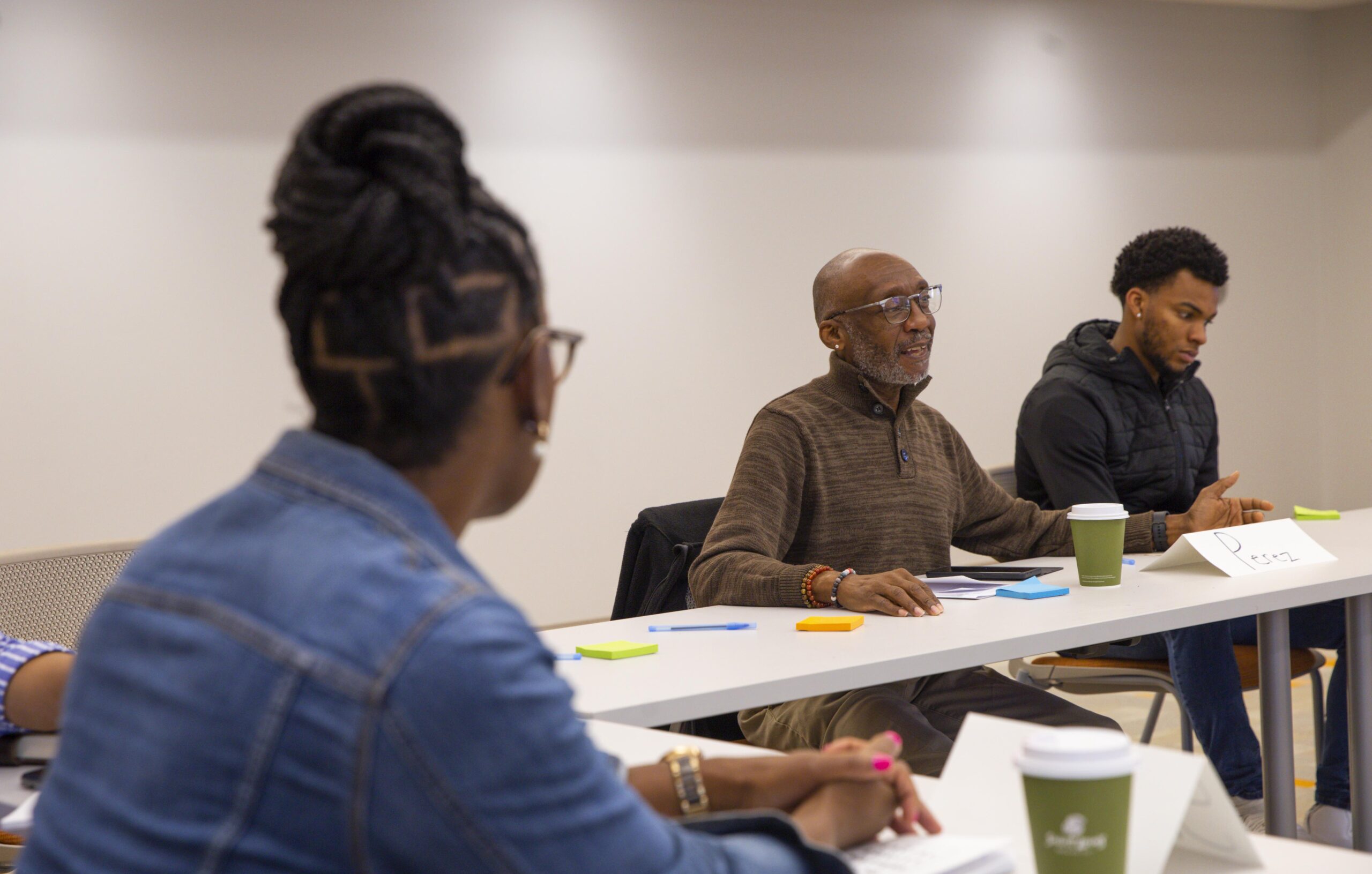
The Community Governance Board (CGB) of the RH + JF Pilot is a voting body of 9-15 Black and Brown community members from St. Louis City, St. Louis County, and St. Clair County who are directly impacted by racialized oppression. The Board reviews applications and has full decision-making power over how funding will be distributed to St. Louis Black and brown communities’ healing efforts, programs, and initiatives. Within this body there are two groups to ensure the sustainability of the fund: a Grants & Allocation workgroup and a Community Voice & Learning workgroup.
Do I need a 501(c)3?
Through the community design process and development of funding priorities, we heard repeatedly the access barriers in traditional philanthropy. We heard about the complex applications, lack of capacity building, and limiting effects of requiring a 501(c)3. We also heard that this Fund could not only invest in “the usual suspects.”
For the first round, we required applicants to have a 501(c)3 or a fiscal sponsor that can lend their status for the project. However, we worked diligently to create systems of support for community members and organizations that do not hold 501(c)3 status or have an EIN number but carry the wisdom of lived experience, to access the granting opportunities. In 2022, we developed fiscal sponsorship accessibility partnerships that allowed organizations without 510(c)3 status to access RH + JF Pilot funding for the second grant cycle.
Can I request general operating funds?
The Racial Healing + Justice Fund considers requests for general operating funds for organizations doing work aligned with the funding priorities and activities.
Glossary
Healing Justice
The intentional practice of delivering healing resources to communities impacted by systemic injustice so that they may heal and be in a position to take advantage of opportunities to thrive and flourish. Definitions of other commonly named forms of justice include:
- Justice: The quality of being just, righteous, equitable, and morally right
- Restorative Justice: a system of criminal justice that focuses on the rehabilitation of offenders through reconciliation with victims and the community at large.
- Transformative Justice: Taking the principles of restorative justice and applying them beyond criminal justice to areas such as environmental law, labor-management, health equity.
- Social Justice: The things we do in everyday interactions that humanize each other and prevent physical and discursive harm.
Healthy
A measurement of existence based on mental and social well-being, not just the absence of disease or impairment. A healthy state of existence is “a state of complete physical, mental and social well-being.” (World Health Organization)
Holistic
An approach to health that focuses on wellness in its entirety. A holistic lens views a person’s emotional, social, spiritual, and physical well being.
Human-Centered
A human-centered framework requires that efforts are community-driven, community lead, community-organized, and community-rooted. Human-centered approaches acknowledge that the most marginalized and endangered people should be centered on problem-solving efforts.
Humanizing Equity©
Humanizing equity is an approach to equity work that ensures those most impacted by injustice are the face of the solution, not the problem. This is accomplished by creating community informed policies, assessing whether those policies positively impact actual lived experience from the community’s perspective, assessing and evaluating those policies for effectiveness in promoting healing justice, being radically inclusive of connected communities, and ensuring that the health of one’s whole self and their community are prioritized.
Participatory Grantmaking
A grantmaking process that centers community inclusion, fosters generative and collaborative partnerships between funders and community, embraces shared governance so power is shared, and utilized transparent participatory budgeting. Participatory grantmaking creates space for all aspects of a grantmaking process to be curated, designed, and driven by leaders of the communities most impacted by any available resource allocation.
Racial Equity
A state in which a person’s life outcomes cannot be predicted by race. When our regional systems (education, housing, healthcare, jobs, transportation, and more) work well for all people so that disparities are eliminated and all residents, regardless of their race and zip code, have the opportunity to thrive.